
I’d intended to feed my cat, but I fed my husband’s appetite for teasing instead.
As I reached to add cat food to Trouble’s bowl in the wee, dark morning hour, something splashed in the water bowl next to it. Startled, I lurched backward, nearly losing the food container.
My husband–on the other side of the glass door–did lose it, laughing at my awkward lunge.
“What was that all about?” Steve asked, feigning sympathy as I reentered the kitchen.
“A frog leaped out of Trouble’s water bowl, and it freaked me out.”
“What kind of frog?” he asked, ready to hunt it down if it were a Cuban tree frog, an invasive species threatening our Florida ecosystem.
(He takes his role in removing infiltrators quite seriously.)
“No, no,” I said, calming him. “It was a normal frog, not a tree frog.”
“Oh, it was a toad,” he corrected me, peering at the amphibian exiting the porch. (It looked like a frog to me, but he was right.) “That’s good news!”
“Um, why?” I asked, thinking anything leaping at me in the dark was not good news.
“Because that means the native toads are back — and we haven’t seen a Cuban tree frog in months.”
That is good news.
Getting rid of an invasive species
Cuban tree frogs are a prolific, invasive species that kill native frogs and, I guess, toads, and usurp their territory. Our state environmentalists say they should be killed “humanely.”
My husband enjoys being their predator. He goes into stealth mode to kill them before they know they’re being stalked.
Not me. I’m afraid of things that leap at night or day.
I’ve only killed one. And that was my fear driving fast enough for the wind to tear it from my driver’s side window where it leered at me through the glass. (That story here.)
Once when a frog was clinging to the doorknob, I was too afraid to enter my own house.
Another time two Cuban tree frogs leaped at me from behind a motion sensor I removed to replace the batteries, I threw the sensor in my fright.
I don’t like leaping frogs (or stationary ones), yet I understood my husband’s delight in the return of the native animal. Well, native toad. (Plus, he was distracted from teasing me about my near-fall.)
The toad’s presence was “good news,” as my husband proclaimed.
Both of us have been vigilant frog watchers–he to slay them humanely, me to alert him when I see one so he can.
This partnership has freed our yard of the invasive pests one by one and forced me to take joy in toads bathing in our mini swimming pool (aka cat water bowl).
The spiritual parallel to invasive species
My state’s permission, indeed, insistence, to kill–humanely–this invasive species to let the native species thrive lends itself to a picture of our spiritual life, doesn’t it?
Isn’t that what we’re supposed to do with bad habits? Or sin? See them and “kill” them?
So our Christ-inhabited “native” righteous behaviors thrive?
Sin is the Cuban tree frog; righteousness is the toad–or all the native species we want in the environment.
(I realize our old, sinful nature was our original “native,” but when we submitted to God and became His, we became the righteousness of Christ, brand-new creations with a new nature [2 Cor. 5:17-21].)
In his letter to the Romans, the Apostle Paul urged believers to keep sin from ruling us:
12 Let not sin therefore reign in your mortal body, to make you obey its passions.
13 Do not present your members to sin as instruments for unrighteousness, but present yourselves to God as those who have been brought from death to life, and your members to God as instruments for righteousness.
14 For sin will have no dominion over you, since you are not under law but under grace. (Romans 6:12-14, ESV)
Just as we Floridians are to prevent invasive species from reigning in our state, we believers in Christ are to stop sin from reigning in us.
Instead of giving that invasive species (sin!) free reign on our property, we should submit to God and present our whole selves as instruments of righteousness instead.
Where the analogy falls short
It’s easy for me to equate the invasive Cuban tree frog with sin. (Oh, if only my aversion to sin were as strong as my fear of these creatures!)
It’s less easy to equate the toad invading my cat’s dish with the righteousness of Christ.
But no analogy is perfect. 😉
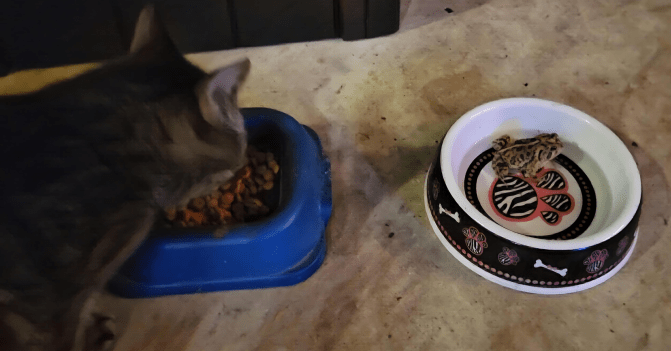
The next morning, I was on high alert as I put food in the cat’s bowl while the toad sat–again–in her water dish. He had lost his fear of me–or his desire to cool himself outweighed his trepidation of this human.
(Or he had seen my graceless leap and knew he had no need to be afraid.)
The toad didn’t move a muscle. I managed to control my own.
My husband, however pleased he was at the return of the native toad, did not see the equivalent of the “righteousness of Christ” in the blob filling the bowl.
He relocated him to the bottom of our yard.


There is good even in the scariest situations! I am glad you and the frog managed to acknowledge each without too much fear 😅
LikeLiked by 1 person
Lol. Yup. I guess there’s something to be said for anticipation. Once I knew he could be there, I was on guard. He might have been, too. (I am just a bit bigger than he is!) 🐸
LikeLike
Yup, we should always be improving and always learning to be the person God made us to be – Smile girl you got this : )
LikeLike