
Finding home in a year when nothing stayed the same
As America approaches its 250th birthday, I’ve found myself thinking back to 1976—a year of celebration, constant change, and a quiet search for something steady. This is a story about the houses we lived in, the friendships that held, and what I came to understand about home.
*****
“I can’t hear you!” Mrs. Francis yelled from the back of the room, cupping her hand around the back of her ear until I spoke loudly enough to earn her thumbs-up.
Day after day, practice after practice, I learned to project my voice for that approval—to fill a room, to reach the back row, to be heard.
But today wasn’t practice. It was our first and only performance of Fruitville Elementary’s musical celebrating America’s bicentennial, and Mrs. Francis was frantic behind the stage, not steady in the cafetorium’s rear. In front of the entire school—students, teachers, and parents, I began the opening narration of Sing, America, Sing.
“Sing, America, Sing!” I boomed, using the same energy Mrs. Francis had demanded.
I was standing behind a microphone—for the first time.
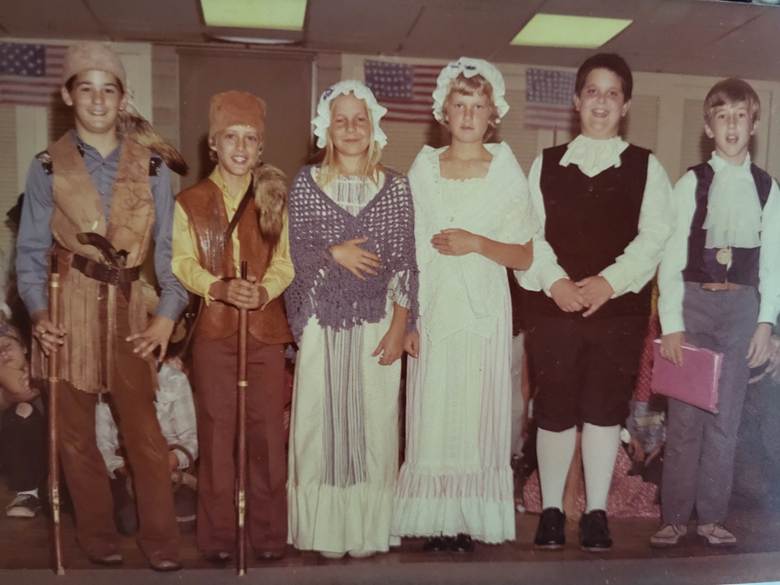
At my booming entry, the audience leaned away as one. I was too loud, uncomfortably so—for them and for my fifth-grade self-esteem.
Red-faced, I lowered my voice: “Sing of the past and the present, of peace and war…”
I finished my first lines and shrank from the mic, suddenly unsure not just how loud to be, but how to belong in the space that heard me.
I was one of several student narrators cycling to the microphone during the play, all of us varying in height. My next lines followed a sixth-grade boy significantly shorter than me. He walked away from the mic stand without raising it. Again, embarrassment.
Being a 10-year-old girl taller than a boy a year older was humiliating enough. Walking toward the too-short microphone made it worse.
Or might have, if not for a classmate who stepped in front of me, raising the mic and giving me an encouraging smile as I walked to say my lines. His kindness made all the difference.
For weeks on end, the fifth- and sixth-grade classes rotated through music and art classes with one aim: Sing, America, Sing, an American heritage pageant featuring music that told our country’s story as we celebrated its birthday. We practiced songs and lines in music class; in art, we created props and scenery. Together, we made a quilt commemorating America’s birthday, each of us embroidering a single square.
*****
The year 1976 was filled with celebration, and today, as we near our country’s 250th anniversary, I find my mind returning to that patriotic world.
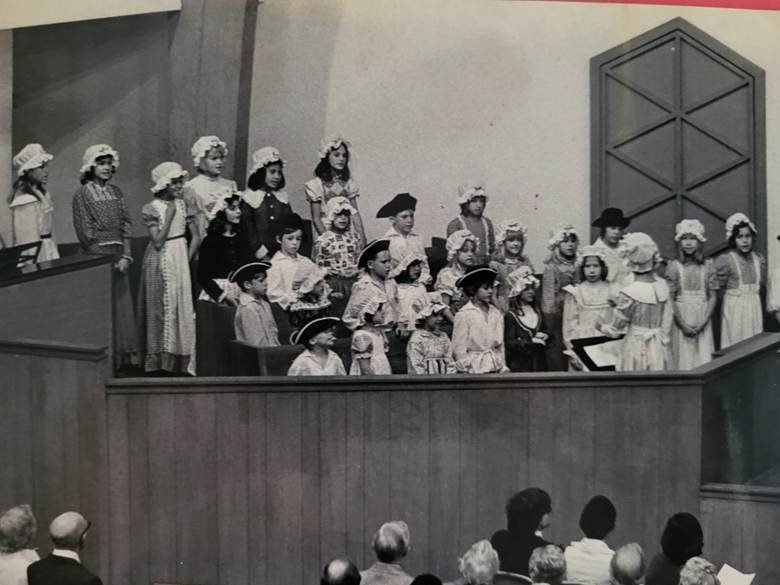
At church, the children’s choir members wore colonial clothing and sang patriotic songs. We even rode in a covered wagon during Sarasota’s parade.
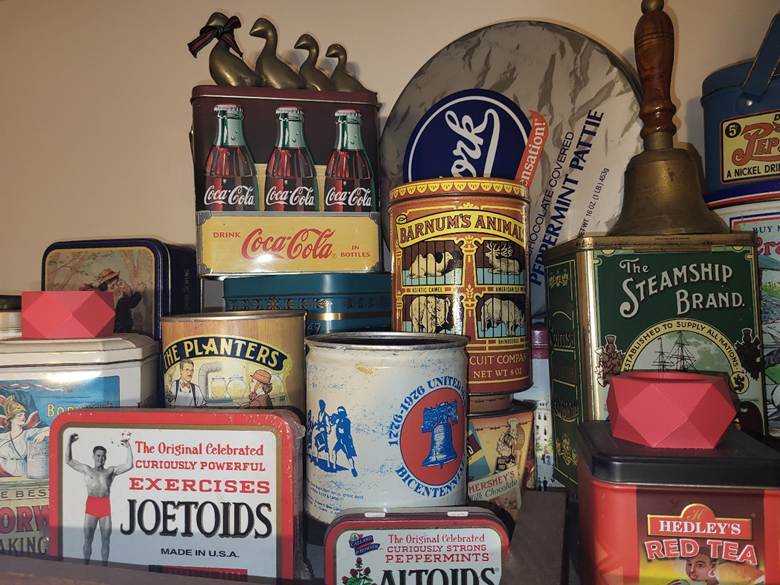
It began, for me, with a tin can of candy fruit drops, long since emptied but still treasured. We sold them as a school fundraiser, and that tin decorated my childhood bedroom, beginning a love of tin containers that still grace my dining room today.
“This land is your land,” we sang. “This land is my land…”
Fifth grade was when I longed for my family to have “a land” of our own—even rented land. Over the previous year, we moved three times, across two school districts.
I had lived my first seven years in one house in Mercerville, New Jersey, but when my father was transferred to Sarasota, Florida, everything I knew was upended—repeatedly—when he left his position with RCA, changed jobs, and we moved, nearly every year. Always within Sarasota County.
As the youngest of five children, I was shielded from the reasons we were moving—money problems, I believed, even then—but my mother had a knack for making even the most ill-fitting house downgrade an exciting proposition for the Souders family. My parents would move us 13 more times before I turned 20—14 more if you count the campsite we lived at for one summer while we waited for a house.
But I didn’t know about any of those future moves in 1974. I only knew moving meant changing schools. My older sister Trish and I would attend Southside Elementary, riding together on a bicycle fitted with a banana seat, the nearly two miles to school. Most days we chose to walk, an easier choice when wearing backpacks, despite the distance.
Though the house we rented was nice, it was too small for our family of seven, so Mom converted the two-car garage into a bedroom for my older brothers, Jack and Scott. And by “converted,” I mean she put their bedroom furniture in a garage, and there they stayed—even when my oldest sister Cyndi left her room vacant when she went away to college.
In November, though my parents scrimped and saved as much as they could, they realized they couldn’t afford this house. In their search for something better, my mom found Mrs. Carey, an older lady who had a small house on 25 acres west of town.
We moved in time to celebrate Christmas in Mrs. Carey’s too-small farmhouse on Tatum Ridge Road. This one didn’t have enough bedrooms—or a garage. My two brothers were relegated to the living room.
It was in yet another new school district, but Mom drove us to Southside so we wouldn’t have to switch midyear.
On the country road, my parents fancied themselves farmers—purchasing chicks, a baby pig, and day-old calves from the dairy. We bottle-fed calves, housed chicks in the barn, and kept Pumpkin the pig with our neighbor’s pigs in his palmetto-filled pen.
I still picture our neighbor Steve Dane throwing himself into those bushes trying to catch the largest pig. Why, I don’t remember, but the sight of that heavyset man flinging himself after them has stayed with me. We lined up along the hog wire fence, cheering.
Those six or seven months were the fullest of our lives. We captured loose horses, raised steers and chickens, befriended neighbors, and welcomed a stray hound and her seven puppies, who took up residence beneath our house. I even watched a horse give birth.
I could have lived there forever. But half a year into our lease, the landlady died, and we had to move again.
By mid-June, we were in our third house since the previous August. The moves, exciting as Mom made them out to be, took their toll.
“Mom?” I said over the phone one night. “I don’t feel well. Could you come get me?”
It was nearly nine. I’d gone home with a new friend after a day at the county’s Lido Beach Summer Recreation program. But as bedtime approached, I grew physically ill.
Homesick.
For what, I couldn’t say. Certainly, not a place—I had none that felt like home.
My family? Friends? In addition to new homes, I was also making new friends because my best friend was no longer allowed to play with me. Her mother decided she was immature—and it was my fault, since I was nearly a year younger. She tore her daughter abruptly from my life.
That homesickness threatened every new friendship I tried to build.
That third house—where we celebrated the nation’s centennial—sat in an orange grove, isolated from neighbors. We had enough pastureland to keep Fert and Lizer, the two steers we’d raised from babies, and a chicken coop built around a sprawling old oak tree.
I climbed that tree often, settling on a long branch that stretched into a horse pasture to read or write. As horses scratched their backs against it, I bounced along, my journal writing turning jagged.
It was great fun.
We had cats and kittens, dogs and puppies—and one large chicken that roamed freely because the others bullied her. We named her Chicken.
For our kindness, she turned on us, attacking whenever we stepped outside. We carried brooms for protection, and when she ended up on our dinner plates, I was both sorry and not sorry. She was the toughest bird we’d ever eaten and the only one of our animals that my parents admitted to slaughtering and cooking.
The girl who named each animal on our farm as if it were a pet, I preferred not to know when we were eating one of them.
(Our two steers went to the slaughterhouse, eventually, but my parents insisted the meat we ate wasn’t theirs. When a chicken stopped laying and then mysteriously disappeared from the coop, my parents blamed foxes.)
*****
The day after my 10th birthday in August, I entered yet another new school—this time with Trish, who was starting junior high. I walked our winding, tree-lined driveway to Fruitville Road, then along the road to catch the bus with boys I didn’t know.
Fear kept me silent—until I walked into my class and saw Cindy, a friend I knew from earlier years at Phillipi Shores Elementary. She was new to Fruitville, too.
We greeted each other as if we’d never been apart and soon gathered the other girls into our circle. Cindy and I went from class to class together, joined the Girl Scout troop, and became immediate best friends.
Under the protective umbrella of her friendship, I spent nights at her house and even went to Girl Scout camp without an inkling of homesickness. I developed friendships that didn’t disappear overnight.
Those bonds—and the year’s celebration of America’s birthday—gave everything a warm glow.
Our homeroom was the art room, and we moved from classroom to classroom for other subjects throughout the day. Like moving from house to house, I carried my people with me. Though the rooms and teachers changed, I was anchored in my friendship with Cindy and the others.
*****
That year, everything celebrated the United States of America. It was her 200th birthday, after all.
We sang about land we claimed as ours, even as I lived in houses that never quite were.
That year, I began to understand something I hadn’t known how to name: home wasn’t the orange grove or the farmhouse or the garage-turned-bedroom.
It was what didn’t move—the familiar face in a new classroom, the girls who formed a circle wide enough to include me, and the voice that, for the first time, didn’t need to shout to be heard—because, for once, it felt like it had one.
Even if it took a microphone—and some awkward moments—to realize it.
Have you ever had a season where everything changed—but something important held steady?


I had to laugh out loud about Chicken, she was tough and hard to digest but we ate her anyway 😂. I can’t imagine moving to so many places and having to build everyone from scratch again but it sounds like you and your family made the most out of it. You got lots of stories and experiences that you could share with your grandkids and the world. Having moved across half way across the world, I miss my friends the most along with family but I know there are just a plane (or 3) away. Happy Birthday America!
LikeLiked by 1 person
Oh my, Sothy! Thanks! And I feel for you being so far from your childhood home. I’m sure you have loads of stories to tell, too! I can’t wait to read them! 😍
LikeLiked by 1 person
Thank you for writing and sharing this! I just watched the film version of Cross Creeks and it made me think of Marjorie Kinnan Rawling’s writing as she adjusted to her new Florida home.
LikeLiked by 1 person
Thanks, Joey! If you enjoyed Cross Creek, you should read The Creek by J.T. Glisson, who grew up in Cross Creek with Marjorie as his neighbor. It’s a fun read anyway, but his takeaways on the famous author make it so much better. I know J.T.’s best friend’s son from the health club.
LikeLike